
In today’s Best website for small business 2026, accelerating digital reality, your online presence isn’t a luxury; it’s how you reach new customers. Your online Business storefront that showcases your brands, products, and services to an online audience. One of the most frequent questions business owners hear is the following:
But a static website or a dynamic website?
Both have their own set of benefits and applications. Knowing the differences, pros, and cons of each of them can help you make the best decision. Static vs dynamic website differences.
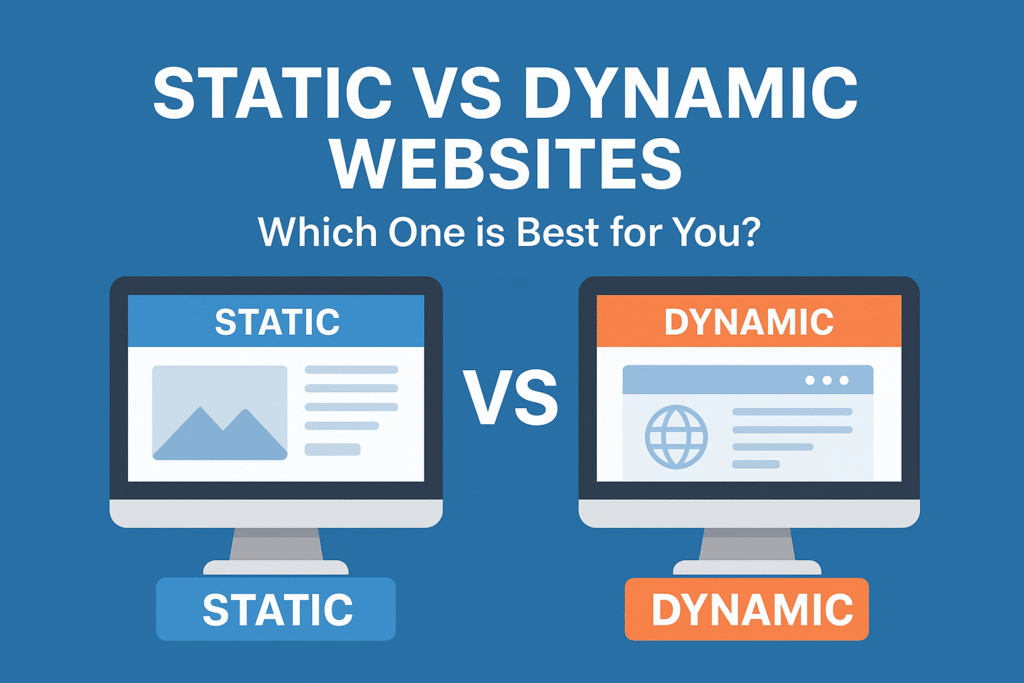
What Is a Static Website?
Static websites are developed using basic front-end technologies such as HTML, CSS, and JavaScript.Each static site page is a separate file on the server, and it appears to every searcher exactly as it does for anyone else. When someone goes to your site, the browser just has to grab the premade HTML file — no fetching and processing data from a database. Difference between Static and Dynamic Websites.
The latter means that static websites are faster and lighter and can be hosted more easily.
Best static website development service
1. High Speed and Performance
Static sites needn’t pull and organize information from big databases, making them crazy fast to load, great for customers, as well as search rankings. Best affordable website design. Static websites are generated and rendered ready for display (pre-rendered) by the build process: HTML, CSS, and JavaScript exist to describe each page before it needs to be loaded. Because there is no server-side processing or database calls, pages load immediately.
Quick loading is good not only for visitors but also for SEO because Google gives priority to websites that deliver a fast and smooth user experience. As such, static sites are a perfect match for businesses looking to offer the best performance and reliability.
2. Low Development and Maintenance Cost
Static websites don’t require complex back-end systems or databases, so development costs can be much less than those of dynamic sites. And maintenance is low ongoing.
Best low-cost website design for small business 2026. Most likely, you will have to change just an HTML file or two, or you can use a static site generator. It is therefore an economically friendly platform for startups, freelancers, and smaller businesses that want to get set up online quickly.
3. High Security
Static sites have no database or server-side processing, so they are immune to hacking attacks and security threats. Low-budget website for startups. The bottom line is that dynamic sites are more vulnerable, since they rely upon server-side scripting and dynamic data. Since there aren’t any databases to hack, or CMS logins for that matter, there’s almost nothing for hackers to get their hands on.
This makes static sites ideal for businesses with light data loads and a preference for increased security over frequent updates.
4. Best for Simple Projects
Perfect for portfolios, landing pages, and company profile sites where you don’t need lots of updates. Static sites are a great option for:
- Personal portfolios or resumes
- Company introduction or profile sites
- Event or product landing pages
- Small informational blogs
Common Problems for Static Websites
1. Difficult to Update
Developer support is required for even a small content change (e.g., updating prices or introducing a new section).Website cost comparison. Static websites are very fast and simple to maintain; a trade-off can be less flexibility for complex applications or long-term options. Let’s explore them in detail. One of the downsides to static websites is that, when you need to make content updates by some means other than a CMS or blog engine, in many cases, a developer has to be involved.
And if there’s a small change you need to make, like changing your product prices, adding new services, or tweaking text, you’ll have to update the HTML files and re-upload them manually.
It’s a nightmare for nontechnical website owners who have to find and decompress the file every time they want an update.
For example, if you run a small business and want to post weekly news or promotions, a static site may not be the best option unless you have someone who can make those regular edits.
2. Limited Functionality
It’s also painful to add contact forms, user login, or commerce. Static websites are great for static content (obviously), but they are not so good if there’s a need for any kind of interactivity.
Because it has no server for your database or server-side scripts (well, you can, it’s just not location-based). Application features that require a server, such as:
- User logins or registrations
- Contact forms that store data
- Shopping carts or payment systems
- Search filters and personalized dashboards
- are infeasible or more complicated to solve.
As a result, static websites are less appropriate for businesses requiring user interaction and dynamic content, such as e-commerce or online reservations.
3. Not Scalable
Static can be hard to maintain if your site requires regular updates or consists of multiple pages. Your website is going to grow – with new pages, blog posts, products, or features, and while scale often breaks things in the development world, static websites can simply become unmanageable.
It’s the problem of making a new page for each option, and as new options are added, it becomes more onerous to maintain.
In the long run, this lack of scalability is a bottleneck. Static websites can be seen as limiting when businesses seek content growth, marketing automation, or engaging users.
What Is a Dynamic Website?
Server Side: Programming languages like PHP, Python, Node.js, etc are used to develop a Dynamic website. JS, or ASP. NET to create dynamic web pages on the fly.
Rather than serving up static files, the server queries a database (such as MySQL or MongoDB) for content and presents dynamic information to the user.
For instance, if you have a blog or an e-commerce site, you’d store every single one of your product posts in a database and then each time someone visits the page where your product post should be displayed.
Advantages of Dynamic Websites
Best Dynamic websites for business growth are designed to change and grow just like our wonderful world. While static sites are static, meaning they stay the same for everyone who visits them (including you), dynamic websites change based on what users do and what data is in the database. They’re all about live content, and real-time personalization makes them incredibly flexible.
Now, let’s go into their main benefits:
1. Easy Content Management
It is obvious that if you have a CMS (Content Management System) running behind your site like WordPress, Joomla or Drupal, then updating the content can be done in no time –no programming required. The most appealing factor of dynamic websites is their content.
They run on a Content Management System (CMS), such as WordPress, Joomla, or Drupal, that enables you to update content and add new pages. You can easily update your site and create new pages.
What this means is that all you business owners, marketers, or non-technical people out there can:
- Upload blogs or images
- Update pricing or product information
- Manage categories and menus
For instance: If you’re the owner of an online shop, you can easily add new products, update offers, or bring seasonal promotions — in real time & with no hassle.
2. Personalized User Experience
You can display content that depends on user actions or dispositions (for example, recommendations, login information, etc.).Dynamic sites enable a more personalized experience for all users. Through cookies, databases, and analytics, your website can display:
- Personalized product recommendations
- Location-based content
- User Dashboards (Order history, saved items)
- Language or currency adjustments
This type of user-centric interactivity can drive engagement, session time, and conversion, all critical metrics for SEO and overall customer satisfaction.
3. Highly Scalable
Scaling with Your Business As your business grows, additional features, pages, or sections can be easily added without having to rebuild your entire site. The Best Dynamic Websites are designed to expand as your business grows.
You can insert new pages, categories, or even full modules (blog section, web shop, or booking system) without overhauling the entire site.
The CMS backend seamlessly integrates with APIs, CRMs, and marketing tools — great for brands that have room to grow their digital footprint.
For Example, A startup might start with a simple company website and eventually grow into an e-commerce platform or client portal — without having to build from the ground up.
4. Ideal for Interactive Websites
Low-cost dynamic websites. Forms, shopping carts, blogs, and dashboards are just a few examples of what dynamic websites can look like. Dynamic web pages allow us to add interactive features to websites, and some of the examples are:
- Contact forms and chat systems
- User logins and registration
- Shopping carts and payment gateways
- Blogging, news posts, and comments
- Dashboards and data reports
These characteristics make dynamic websites ideal for businesses, online shops, e-learning institutes, and applications with Software as a Service that depend on user input.
5. Seamless Integration with Marketing Tools
Dynamic websites of today’s era can be connected to external services such as:
- CRM systems (e.g., HubSpot, Salesforce)
- Email marketing tools (Mailchimp, SendGrid)
- Analytics platforms (Google Analytics, Hotjar)
- Payment gateways (PayPal, Stripe, Razorpay)
With that integration, businesses can monitor performance, stay ahead of leads, and automate marketing campaigns for informed decisions and improved ROI.
Common Problems with Dynamic Websites
1. Slightly Slower Load Speed
Because every page is generated dynamically, a Dynamic website for business growth, you might have to wait some time until the content is loaded. When you visit a website, most of the websites are not static, which means that pre-coded HTML files will be shown to you as soon as you make a request(navigating) to it on your web browser. js, or Python).
Meaning each time a visitor requests/reloads a page, the server needs to:
- Fetch content from the database
- Process it through the CMS
- Then render it in real-time
All of this adds a minor delay to the loading of the page. Dynamic websites can also become load-heavy, and if not optimized, they might slow down, leading to poor user experience, and then we lose s site rank in the search engines.
2. Higher Development Cost
Dynamic sites take more time, expertise, and resources to build and maintain. Dynamic web applications are harder to design than static ones. They need a backend developer and often, CMS installation, Database setup, and Plugin configuration. Affordable website design company. This raises the up-front cost of development. Looked at another way, maintaining dynamic websites may also mean never-ending investment in:
- Hosting (because it’s a bit heavier in terms of server)
- Keep CMS and plugins up to date
- Technical support for troubleshooting
So, for startups or on-budget individuals, it could be a bit expensive.
3. Requires Maintenance
Requires frequent updates for CMS, plugins, and security patches. Top Dynamic websites are only as good as the sum of their parts — CMS, themes, plugins, and databases. To keep them durable and in place, there are some regular maintenance requirements you need to follow, including:
- Updating the CMS (like WordPress, Joomla, etc.)
- Applying security patches
- Monitoring for plugin conflicts
- Backing up data regularly
Failure to update these can put you at risk of security threats, hinder performance, or even cause your website to go down.
How Do You Know Which Is The Right One For You?
Whether to go with static or dynamic is a matter of business objectives, budget as well the purpose of the website. Ask yourself these questions:
- Should I be keeping my content fresh and up to date?
- Can users perform actions (log in, comment, buy them) on my content?
- Am I on a budget and need something basic?
Pick a Static Website if:
- You need a fast, affordable, and secure website.
- You rarely update your content.
- You want a portfolio, brochures, or a company info site.
Pick A Dynamic Website If It’s best for: You want to blog or content manage with ease.
Why Alfa Coders Is the Right Choice
At Alfa Coders, we don’t just create websites — we create digital experiences. Our talented team of developers and designers assists you in selecting the right type of website for your business needs, audience, and budget.
Our Expertise Includes:
- Static custom websites, uniform shot of home design and development for a static website
- Dynamic, WordPress, PHP, and MERN Stack Websites
- eCommerce and business portals
- SEO optimized and website speed boosted
- Ongoing maintenance and security management
We make sure your website is beautiful and performs like a beast!